
Author: Malik Sherjeel Awan

  • Small Space Decor Ideas for Your First Home or Rental

    Small Space Decor Ideas for Your First Home or Rental

    Your first home or apartment may be smaller than the places you scrolled past online. The good news is that a compact room can feel calm, open and personal with a few smart choices. These small space decor ideas focus on layout, light, storage and safety, and most work whether you rent or own.

    Educational only. The Property Question shares general home tips, not professional design, safety, or legal advice. If you rent, check your lease and ask your landlord before drilling, painting, or changing fixtures.

    Quick answer

    The best small space decor ideas start with a clear walking path, then add light, mirrors and storage that works vertically. Pick fewer, multi-use pieces, keep colours consistent, and anchor tall furniture to the wall, as the U.S. Consumer Product Safety Commission’s Anchor It! campaign recommends.

    Key takeaways

    • Plan before you buy: measure the room, doors and walkways first.
    • Go vertical: wall shelves and tall storage free up the floor.
    • Use light and mirrors: they make a room feel brighter and more open.
    • Choose double-duty furniture: storage ottomans, drop-leaf tables, sofa beds.
    • Safety first: anchor dressers, bookcases and TVs, per CPSC Anchor It!

    Start with the layout, not the shopping basket

    The most common small-room mistake is buying furniture first and hoping it fits. Measure the room, the doorways and the hallway the furniture has to pass through. Sketch the floor plan on paper, or mark furniture footprints on the floor with painter’s tape.

    Keep a clear walking path from the door to windows and other rooms. A room that is easy to move through feels larger, even if nothing else changes.

    Float one key piece, like a sofa or bed, and build around it. In a studio, a rug or a bookcase can quietly divide “living” from “sleeping” without adding walls.

    Plan a small room in five steps

    1

    Measure everything: room, windows, doors, radiators and outlets.

    2

    Map the walking path: keep it clear from the entrance to each zone.

    3

    Pick the anchor piece: the sofa, bed or table the room is built around.

    4

    Add storage next: vertical shelves, under-bed bins or a storage bench.

    5

    Finish with light and decor: lamps, a mirror, a few personal pieces.

    Make light and colour work harder

    Light is the cheapest way to make a small space feel bigger. Use sheer curtains that let daylight in, and hang curtain rods a little higher and wider than the window so it looks larger.

    Layer your lighting: a ceiling light, a floor or table lamp, and a small task light where you read or work. Lamps in corners push light into the edges of the room, which helps it feel wider.

    A large mirror opposite or beside a window bounces light around. Keep wall colours, rugs and big furniture in a similar, light palette, then add colour through cushions, art and plants that are easy to change.

    Tip

    When you plug in lamps, follow the U.S. Fire Administration’s advice: use bulbs that match the fixture’s recommended wattage, keep anything that can burn away from lamps and bulbs, and don’t overload outlets or power strips.

    Storage that hides clutter and saves floor space

    Clutter makes any room feel smaller. Aim for storage that is either vertical (shelves, tall cabinets, over-door racks) or hidden (under-bed drawers, lidded baskets, a storage ottoman).

    Pieces that do two jobs earn their place. A bench with storage at the entrance holds shoes and gives you a seat. A drop-leaf or wall-mounted folding table becomes a desk by day and a dining table by night.

    GoalRenter-friendly optionOwner option
    More storageFreestanding shelves, over-door racks, under-bed binsBuilt-in shelves or fitted wardrobe systems
    Brighter roomFloor and table lamps, plug-in wall sconcesHardwired fixtures or extra ceiling lights
    Wall colourArt, removable wallpaper where the lease allowsPaint any colour you like
    Window lookTension rods or lease-approved hardwareNew curtain rods, blinds or shutters
    Room dividerOpen bookcase, rug, folding screenHalf wall or built-in partition
    Small-space upgrades: renter vs owner options

    Keep it safe: anchor tall furniture and manage cords

    Tall, narrow storage is great for small rooms, but it can tip. The CPSC’s Anchor It! campaign says anchoring furniture and TVs should be part of your childproofing plan. It recommends installing an anti-tip kit right away, the day the furniture or TV arrives.

    According to Anchor It!, kits have brackets for the furniture and the wall, joined by a strap. The kit’s instructions tell you how many straps you need, and usually two are used. Flat-screen TVs can be wall-mounted, or placed on furniture designed for TVs and then anchored.

    Small rooms often mean extension cords, too. The U.S. Fire Administration warns against putting cords where they can be pinched or damaged, like under a carpet or rug, and says to replace worn or damaged cords right away.

    Warning

    Renters: anchoring usually means screws in the wall. Ask your landlord first, and use the hardware your lease allows. Never skip anchoring tall dressers or bookcases in a home with children just to avoid small holes.

    For outdoor ideas, see our guide to simple curb appeal updates. Still house hunting? Use our method to compare house listings and check room sizes before you visit.

    Small-space decor checklist

    • Room, doors and walkway measured before buying
    • Clear path from the entrance to every zone
    • At least one piece of vertical or hidden storage
    • Layered lighting: overhead, lamp and task light
    • A mirror placed to bounce daylight
    • Tall furniture and TVs anchored (with landlord OK if renting)
    • No cords under rugs; outlets and power strips not overloaded

    Frequently asked questions

    Do I need to anchor furniture in a rental?

    Anchor It! recommends anchoring tall furniture and TVs, which usually means screws in the wall. Ask your landlord first and follow your lease.

    How many anchoring straps does a dresser need?

    Follow the kit’s instructions. Anchor It! says the kit tells you how many straps are needed and that usually two are used (Anchor It!).

    Is it safe to run an extension cord under a rug?

    No. The U.S. Fire Administration warns against placing cords where they can be pinched or damaged, such as under a carpet or rug (USFA).

    What should I buy first for a small room?

    Measure first, then choose the main piece the room is built around, and add storage before decor.

    Last checked: 16 November 2026. Safety guidance can change; follow product instructions and the official sources listed below.


  • Mortgage Lender vs Servicer: Who Handles Your Home Loan?

    Mortgage Lender vs Servicer: Who Handles Your Home Loan?

    A few months after closing, many homeowners receive a letter saying that a different company will now collect their mortgage payments. It can be unsettling if you do not know why. The answer usually lies in the difference between a mortgage lender and a mortgage servicer. This guide explains both roles and what to do when your loan changes hands.

    Educational only. The Property Question is not a lender, adviser or lawyer. This article is general education, not financial or legal advice. Confirm anything about your own loan directly with your servicer, using contact details from your official statement.

    Quick answer

    Short answer: Your lender is the institution that originally lent you the money. Your servicer is the company that sends your statements and handles day-to-day tasks on the loan. It is common for a different company to take over servicing after you take out a loan (CFPB).

    Key takeaways

    • Lender: originally lent you the money.
    • Servicer: sends statements and manages the loan day to day.
    • Changes are common: another company often takes over servicing after closing.
    • Find yours: check your monthly statement or payment coupon book (CFPB).

    What a lender does

    The Consumer Financial Protection Bureau (CFPB) describes your mortgage lender as the financial institution that originally loaned you the money. The lender is who you dealt with when you applied, received your Loan Estimate and closed.

    What a servicer does

    Your servicer is the company that sends your mortgage statements and handles the day-to-day management of your loan. According to the CFPB, a servicer typically:

    • processes your loan payments;
    • responds to your questions;
    • keeps track of principal and interest paid;
    • manages your tax and insurance escrow account, if you have one.

    The servicer can also offer options if you are falling behind on payments, and can start foreclosure in certain circumstances.

    Lender and servicer compared

    LenderServicer
    Main roleProvides the loanManages the loan day to day
    When you deal with themApplication and closingEvery month after closing
    Sends statementsNot usually, unless also the servicerYes
    Escrow accountSets it upManages it
    Two roles in one loan

    Sometimes the lender and the servicer are the same company. Often they are not, and the CFPB notes that it is common for a different company to take over as servicer after you take out a loan.

    Finding out who your servicer is

    The CFPB suggests checking your monthly mortgage statement or payment coupon book first. If you cannot find either, it mentions the MERS Servicer Identification System, run by a private company that keeps information about mortgage loans and servicers.

    Warning

    If you receive a letter saying your servicer has changed, check it against your own statement and contact details you already trust before you change where you send payments. Never use contact details from an unexpected message alone.

    When your servicer changes

    What to do after a servicing change

    1

    Read the notice carefully: note the new company’s name and the date of the change.

    2

    Verify it independently: compare with your statement or contact your current servicer using details you already have.

    3

    Update your payments: change automatic payments only once you have confirmed the details.

    4

    Check your escrow: make sure tax and insurance payments carry over (CFPB).

    5

    Keep records: save the notices and your first statement from the new servicer.

    Tip

    A change of servicer does not normally change your loan terms. If anything on a new statement looks different, ask your servicer to explain it in writing.

    To understand the escrow side of your payment, read our guide to mortgage escrow accounts along with closing costs explained.

    Frequently asked questions

    Why did my mortgage move to another company?

    The CFPB notes it is common for a different company to take over as servicer after a loan is made.

    Does my lender still matter after closing?

    Day-to-day contact is usually with your servicer, which sends statements, processes payments and manages escrow.

    How do I find my mortgage servicer?

    Check your monthly statement or payment coupon book first (CFPB).

    Who do I call if I am struggling to pay?

    Contact your servicer. The CFPB says servicers can offer options if you are falling behind.

    Last checked: 16 November 2026. Sources: Consumer Financial Protection Bureau pages linked above.

  • Title Insurance Explained: Owner’s vs Lender’s Policies

    Title Insurance Explained: Owner’s vs Lender’s Policies

    Among the many line items at closing, title insurance is one of the least understood. Buyers often see two policies and wonder whether they need both. This guide explains what title insurance protects against, how the owner’s and lender’s policies differ, and what to check before you sign.

    Educational only. The Property Question is not a lender, adviser or lawyer. This article is general education, not financial or legal advice. Rules vary by state, lender and loan, so confirm details with the professionals handling your purchase and the official sources linked below.

    Quick answer

    Short answer: Title insurance protects against certain legal claims on a home from before you bought it. Most lenders require a lender’s policy, which protects the amount they lend; an owner’s policy is usually optional and can help protect your own investment (CFPB).

    Key takeaways

    • What “title” means: your legal ownership, transferred to you by a deed.
    • Claims it covers: for example a previous owner’s unpaid taxes or unpaid contractors.
    • Lender’s policy: most lenders require it; it protects the loan amount.
    • Shopping: you can usually shop for title insurance separately from your mortgage (CFPB).

    What title insurance is

    When you buy a home, you usually receive a deed showing that the seller transferred their legal ownership, or title, to you. Title insurance can protect you if someone later says they have a claim against the home from before you bought it (CFPB).

    The Consumer Financial Protection Bureau (CFPB) gives examples: a claim could come from a previous owner’s failure to pay taxes, or from contractors who say they were not paid for work done before your purchase.

    Owner’s vs lender’s policy

    Lender’s policyOwner’s policy
    Who it protectsThe lenderYou, the homeowner
    What it protectsThe amount lentYour investment in the home
    Usually required?By most lendersUsually optional
    Where you see itLoan Estimate and closing papersLoan Estimate and closing papers
    Two policies, two purposes

    The CFPB notes that most lenders require you to buy a lender’s policy. You may also choose an owner’s policy. If you do, the total cost is usually lower when the same provider issues both policies, compared with buying them separately.

    Note

    This article quotes no premium figures. Title insurance costs vary by state, price and provider, so rely on the quotes and disclosures you actually receive.

    Shopping for title insurance

    You can usually shop for your title insurance provider separately from your mortgage, and the CFPB says shopping could save you money. Your Loan Estimate, which a lender must give you within three business days of your application, lists estimated closing costs so you can compare (CFPB).

    Checking the figures at closing

    Depending on your state, your settlement agent, lawyer, lender, estate agent or title company may give you an itemised list of fees at closing. The CFPB says this list could differ from your Loan Estimate or Closing Disclosure, and that a difference does not necessarily mean you are being overcharged.

    Your Closing Disclosure must arrive at least three business days before closing, giving you time to compare final costs with the estimate and ask questions (CFPB).

    Five checks on title insurance

    1

    Find both policies: look for lender’s and owner’s title insurance on your Loan Estimate.

    2

    Ask what is required: confirm with your lender which policy they need.

    3

    Compare providers: ask whether you can choose your own title company.

    4

    Ask about bundling: check whether using one provider for both policies lowers the total.

    5

    Compare at closing: match the Closing Disclosure and any itemised list against your estimate.

    Tip

    Ask questions during the three-day Closing Disclosure window rather than at the closing table, when time is short.

    See also our guides to closing costs and what happens at a home inspection.

    Frequently asked questions

    Do I have to buy owner’s title insurance?

    Most lenders require a lender’s policy. An owner’s policy is usually your choice; ask your lender and settlement professional what applies to you.

    What kind of problems does title insurance cover?

    The CFPB gives examples such as a previous owner’s unpaid taxes or contractors claiming they were not paid for earlier work (CFPB).

    Can I choose my own title insurance company?

    You can usually shop for title insurance separately from your mortgage. Confirm the options with your lender.

    Why does my itemised fee list differ from my Closing Disclosure?

    The CFPB says the itemised list may differ and that this does not necessarily mean you are charged the wrong amount. Ask your settlement agent to explain any difference.

    Last checked: 16 November 2026. Sources: Consumer Financial Protection Bureau pages linked above.

  • Home Offer Contingencies: Inspection, Financing, Appraisal

    Home Offer Contingencies: Inspection, Financing, Appraisal

    A purchase offer is more than a price. In many U.S. markets, buyers add contingencies: contract conditions that must be met, or you may walk away under the terms you negotiated. This guide focuses on the three buyers ask about most: inspection, financing, and appraisal, with a short Canada note.

    Educational only. The Property Question is not a real estate agent, lawyer, or lender. This article is general education, not legal or financial advice. Contract forms and deadlines vary by state and province. Rely on your agent or lawyer and the written contract before you waive anything.

    Quick answer

    Contingencies are conditions in your purchase contract. The CFPB recommends making an offer contingent on obtaining financing and on a satisfactory inspection, so you are not locked into buying if the loan fails or serious defects appear. An appraisal contingency helps if the home appraises below the agreed price.

    Key takeaways

    • Financing + inspection: the CFPB says it is a good idea to make your offer contingent on both (CFPB).
    • Inspection ≠ appraisal: an inspector checks condition for you; an appraiser estimates market value for the lender.
    • Low appraisal is risky: the CFPB says buying above appraised value is very risky and often supports renegotiating the price.
    • Deadlines matter: rights usually expire on a calendar in the contract. Miss them and protection can disappear.

    Why contingencies exist

    Without contingencies, you can be contractually required to buy even if financing falls through or the home has serious flaws. With them, you usually have a defined window to investigate, negotiate, or cancel under the contract’s rules.

    Sellers may push for fewer conditions in a hot market. That is a business choice with real risk. The educational move is to understand what you give up before you waive anything.

    Inspection contingency

    A home inspection is your chance to learn about the property’s condition before you are fully committed. The CFPB advises scheduling as soon as you have chosen a home, so there is time for follow-up inspections and decisions.

    If your purchase contract is contingent on a satisfactory inspection, the CFPB says you generally have the right to cancel without penalty if you are not satisfied with the results. You may also negotiate repairs or a credit. Whether the seller agrees depends on the contract and the local market.

    Note

    An inspection is not an appraisal. The inspector works for you on condition. The appraiser estimates value for the lender. You generally need both when you borrow to buy.

    Financing contingency

    A financing (or mortgage) contingency ties the deal to your ability to get the loan you need. The CFPB groups it with inspection as a core protection: if you cannot get a loan, you should not be forced to buy.

    This contingency works best when your preapproval is already in hand and you keep answering underwriting requests on time. A contingency does not replace incomplete paperwork.

    Using contingencies without missing deadlines

    1

    Read the contingency calendar on day one: note inspection, financing, and appraisal end dates.

    2

    Book the inspection immediately: leave room for specialists if something is flagged.

    3

    Keep your lender updated: job changes, new debt, or large deposits can affect financing.

    4

    Ask what happens if a deadline passes: in writing, through your agent or lawyer.

    5

    Decide in writing before the window closes: repair request, renegotiation, proceed, or cancel under the contract.

    Appraisal contingency

    Lenders generally require an appraisal. The CFPB’s home loan toolkit notes that the appraiser estimates market value, and you are entitled to a copy before closing.

    If the appraisal comes in below the sale price, the CFPB says purchasing above appraised value is very risky. Practical next steps it describes include getting your copy of the appraisal, asking the seller to reduce the price (the low appraisal supports that request), or considering cancellation, with legal advice about any costs under your contract.

    ContingencyWhat it protects againstTypical next step if it fails
    InspectionSerious condition problemsRepair credit, renegotiate, or cancel if allowed
    FinancingLoan denial or unacceptable termsExtend, switch lenders, or cancel if allowed
    AppraisalValue below contract priceRenegotiate price, bring more cash, or cancel if allowed
    Three common contingencies

    Warning

    Waiving contingencies can make an offer look stronger to a seller, and it can leave you obligated to close with less room to exit. Do not waive protections you do not fully understand. Ask your agent or a real estate attorney what your state’s form actually says.

    A note for buyers in Canada

    Canadian purchase contracts often use conditions (for example, financing and home inspection) rather than the U.S. word “contingencies.” The idea is similar: you negotiate time to satisfy conditions before the deal becomes firm.

    Timelines, deposit rules, and what “firm” means are provincial and contract-specific. The FCAC’s mortgage materials stress that a preapproval is not a final mortgage approval. The lender still reviews the property. Work with your realtor and, where customary, a real estate lawyer so condition dates are clear before you waive them.

    For process context, see our Canada first-time buyer basics and US first-time checklist.

    The bottom line

    Inspection, financing, and appraisal protections exist so a bad surprise does not become a forced purchase. Know what each contingency covers, watch the deadlines, and treat any waiver as a deliberate risk, not a casual perk for the seller.

    Last checked: 16 November 2026. Contract forms and local customs change; confirm details with your agent or lawyer and the official sources listed below.

  • Buying a Condo vs House: How First-Time Buyers Decide

    Buying a Condo vs House: How First-Time Buyers Decide

    For many first-time buyers, the first fork in the road isn’t granite counters. It’s condo versus house. The better choice depends on lifestyle, maintenance tolerance, and the full monthly cost picture, not a single sticker price. This framework keeps the decision grounded without inventing market prices.

    Educational only. The Property Question is not a real estate agent, appraiser, or financial adviser. This article is general education, not financial or legal advice. Condo laws, fees, and insurance rules vary by state, province, and building. Confirm details with your agent, lawyer, and the governing documents for any specific property.

    Quick answer

    Choose a condo when you want shared exterior maintenance and amenities and can budget predictable condo fees (plus special assessments). Choose a house when you want more control over the structure, yard, and renovations, and you can handle less predictable maintenance. Compare total monthly housing cost and lifestyle fit, not purchase price alone.

    Key takeaways

    • Condo fees are not optional: CMHC notes fees fund common-element care and often a reserve fund; unpaid fees can lead to serious consequences.
    • Houses shift maintenance to you: roof, exterior, driveway, and yard are typically your responsibility and your budget risk.
    • Insurance differs: houses usually need a full homeowners policy; condos split coverage between a master policy and your unit policy (NAIC / CMHC).
    • Resale and rules differ: condo living includes bylaws, boards, and shared decision-making.

    Frame 1: lifestyle and control

    Start with how you want to live day to day.

    Condo life often means less hands-on exterior work. Snow removal, landscaping, and some building systems may be handled through the corporation or association and paid via fees. You share walls, amenities, and rules. Quiet hours, pets, rentals, and renovations can all be limited by bylaws.

    House life usually means more privacy and control: yard use, exterior changes, and timing of repairs are largely yours (subject to local codes and any HOA). That freedom comes with the work and the surprise invoices.

    The CFPB’s home-shopping guidance encourages matching the home to your real needs and planning for contingencies. Apply the same honesty here: if you travel often or dislike DIY, a well-run condo can fit; if you want a garden workshop and full control, a house may fit better, if the budget supports maintenance.

    Frame 2: the cost picture (without invented prices)

    Ignore viral “average prices.” Build a personal monthly stack instead.

    Cost frameCondoHouse
    Mortgage + taxesYesYes
    Recurring feesMonthly condo / HOA feesHOA fees only if applicable
    Exterior / major systemsOften shared via fees + reserve fundMostly your direct cost
    InsuranceUnit policy + share of master policy costs (via fees)Full homeowners policy
    Maintenance surprise riskSpecial assessments possibleRoof, HVAC, foundation surprises on you
    AmenitiesMay be bundled in feesYou build or buy them yourself
    Condo vs house, cost frames

    CMHC’s condominium cost chapter lists recurring items buyers should budget: condo fees, property taxes, unit insurance, mortgage payments, utilities (if not in fees), and a contingency for unit repairs. For purchase day, it also flags legal fees, land transfer tax where applicable, and other closing items: the same family of costs explained in our closing costs guide.

    Warning

    Condo fees can rise, and special assessments can appear when reserves are thin. CMHC urges buyers to check the reserve fund status in disclosure or status/estoppel certificates before purchasing. A low fee today is not automatically a bargain.

    Frame 3: documents and questions that decide it

    Lifestyle preference is not enough. Verify the specific building or lot.

    A simple decision sequence

    1

    Write your non-negotiables: commute, stairs vs elevator, outdoor space, pets, home office, noise tolerance.

    2

    Build a full monthly number: mortgage estimate, taxes, insurance, fees, utilities, savings for repairs.

    3

    For condos, read the governing packet: budget, reserve fund, bylaws, rental rules, insurance deductibles, pending lawsuits or special assessments.

    4

    For houses, plan a thorough inspection: roof, structure, mechanicals, drainage, and a cash reserve for early repairs.

    5

    Compare two real finalists side by side: same monthly budget, different property types, using listing comparison habits.

    6

    Only then pick a type: the winner should fit both the spreadsheet and a normal Tuesday evening in that home.

    Tip

    Ask what percentage of units are owner-occupied in a condo building. CMHC notes that a high rental share can change community feel and maintenance priorities. It is information, not a rule.

    Where rent-vs-buy and preapproval fit

    If you are still unsure whether to buy at all, use our rent vs buy framework before you debate condo versus house. When you are ready to shop, a mortgage preapproval helps you test both property types inside one budget ceiling, without treating the preapproval amount as a target.

    US shoppers can lean on the first-time homebuyer checklist; Canadian shoppers can start with Canada first-time buyer basics and CMHC’s condominium buyer materials for building-specific diligence.

    No universal “better” choice

    A small condo near work can beat a larger house with a brutal commute. A modest house with a paid-off roof plan can beat a condo with rising fees. The framework is personal fit plus verified documents, not a ranking of property types.

    The bottom line

    Condo versus house is a lifestyle-and-cost decision. Map control versus shared maintenance, build a full monthly stack, and verify reserve funds or major-repair risk before you fall in love with a listing photo.

    Last checked: 16 November 2026. Condo legislation and fee practices change; confirm details with local professionals and the official sources listed below.

  • Homeowners Insurance Basics: Coverage and Questions

    Homeowners Insurance Basics: Coverage and Questions

    Most mortgage lenders require homeowners insurance before closing. The policy is a package: it can help repair the home after certain disasters, replace belongings, and cover liability if someone is hurt and you are found responsible. Coverages and exclusions vary by insurer and state or province, so treat this as a map, not a policy.

    Educational only. The Property Question is not an insurer, agent, or broker. This article is general education, not insurance or legal advice. Read your own declarations page and policy forms, and ask a licensed professional in your area before you buy or change coverage.

    Quick answer

    Homeowners insurance typically bundles protection for the dwelling, other structures, personal property, loss of use (extra living costs while repairs happen), and personal liability / medical payments. Flood and earthquake usually need separate coverage. Ask what perils are covered, how rebuilding is valued, and what your deductible is.

    Key takeaways

    • Package policy: NAIC describes homeowners insurance as covering structure, belongings, and liability for covered accidents.
    • Lenders usually require it: NAIC notes most mortgage lenders require coverage with the homeowner listed appropriately on the policy.
    • Perils matter: policies pay for causes of loss listed (or all except exclusions). Fire and wind are common; flood often is not.
    • Deductible first: you pay the deductible; the insurer shares losses above that threshold.

    The coverages people mean by “homeowners”

    The National Association of Insurance Commissioners (NAIC) summarizes common coverage types this way:

    Typical pieces of a homeowners package

    • Dwelling: damage to the house and attached structures
    • Other structures: fences, sheds, and similar detached structures
    • Personal property: furniture, electronics, clothing, and other belongings
    • Loss of use: some additional living expenses during covered repairs
    • Personal liability: financial loss if you are found responsible for injury or property damage to others
    • Medical payments: medical bills for people hurt on your property or by your pets (policy terms apply)

    Optional add-ons the NAIC lists include sewer/drain backup, umbrella liability, and separate flood or earthquake policies. Insurers differ on what is standard versus optional in your state or province.

    What standard policies often leave out

    A common surprise for first-time buyers: flood and earthquake damage are frequently excluded from standard homeowners policies. NAIC materials treat flood and earthquake as separate products or add-ons for people in higher-risk areas.

    Routine wear and tear, poor maintenance, and some water-related losses (depending on the form) may also fall outside coverage. The only reliable list is the one in your policy.

    Warning

    Do not assume a homeowners policy covers flood. If you are in a flood-prone area, ask specifically about flood insurance through the options available where you live. Waiting until after a storm is too late.

    Questions worth asking before you bind coverage

    Shop the coverage, not only the premium. NAIC’s consumer guide stresses understanding limits, perils, and responsibilities before a claim.

    Questions to ask an agent or broker

    1

    Is the dwelling limit enough to rebuild? Coverage should reflect rebuilding cost, not only purchase price or market value.

    2

    Is personal property replacement cost or actual cash value? Depreciation changes what you receive after a loss.

    3

    What is my deductible, and is there a special hurricane or wind deductible? Higher deductibles usually mean lower premiums, but more out-of-pocket cost after a claim.

    4

    Which perils are excluded? Ask specifically about flood, earthquake, sewer backup, and ordinance-or-law (code upgrade) costs.

    5

    What liability limit do I have, and do I need an umbrella? Liability needs vary with assets and risk tolerance, get licensed advice.

    6

    How do claims and discounts work? Ask about documentation, home inventory, and credits for alarms or roof updates.

    Tip

    Create a simple home inventory (photos plus approximate values) before you move in. NAIC points consumers to inventory tools because proving what you owned is much harder after a fire or theft.

    How insurance connects to buying and closing

    Lenders typically want proof of coverage before funding. Build shopping time into your closing timeline so you are not forced into the first quote you see.

    Your total monthly housing payment often includes an escrow for taxes and insurance. That escrow amount can change when the insurer renews or when taxes are reassessed, even on a fixed-rate mortgage, as the CFPB notes when explaining fixed loans.

    If you are buying a condominium, coverage is split between the corporation’s master policy and your unit owners policy. CMHC’s condominium guidance stresses reading both: contents, improvements, loss assessment, and deductible chargebacks matter. Condo rules differ across Canada and U.S. states.

    Typical detached houseTypical condominium
    Building structureOften on your homeowners policyOften largely on the condo corporation / association master policy
    Your belongingsOn your policyOn your unit owners / HO-6-style policy (names vary)
    Shared areasN/AMaster policy + condo fees / assessments
    Extra questionRebuild cost for the whole homeDeductible chargebacks and loss-assessment coverage
    House policy vs condo setup (general)

    Insurers and regions vary

    Forms, deductibles, and required endorsements differ widely. A coastal wind deductible, a wildfire underwriting rule, or a condo bylaw insurance requirement can change what “basic” means where you live. Ask locally.

    The bottom line

    Homeowners insurance is a rebuild-and-liability safety net with real gaps. Confirm dwelling limits, exclusions, deductibles, and liability before you bind a policy, and shop more than one quote with the same coverage questions.

    Last checked: 16 November 2026. Policy forms and insurer practices change; confirm details with a licensed professional and the official sources listed below.

  • Fixed vs Variable Mortgage Rates: How to Compare Them Calmly

    Fixed vs Variable Mortgage Rates: How to Compare Them Calmly

    Choosing between a fixed and a variable (or adjustable) mortgage is less about picking a “winner” and more about matching the loan’s risk to your budget and timeline. This guide explains how each type works in the United States and Canada, what to compare, and which questions to ask before you sign.

    If you’re comparing a US-style fixed-rate loan with an adjustable-rate mortgage (ARM), see our guide to fixed-rate vs adjustable-rate mortgages and what to ask.

    Educational only. The Property Question is not a lender, broker, or financial adviser. This article is general education, not financial or legal advice. Product names and rules differ by lender and country, so confirm details with your lender and the official sources below.

    Quick answer

    A fixed-rate mortgage keeps the same interest rate for the loan’s life (US) or for the term (Canada). A variable or adjustable-rate mortgage (ARM) can move after an initial period, so your payment may rise or fall. Compare payment certainty, how adjustments work, and whether you could still afford the maximum payment allowed under the contract.

    Key takeaways

    • Fixed: rate set at takeout and does not change for the life of a US loan (CFPB).
    • ARM / variable: rate can rise or fall after an introductory period; payments can change.
    • Stress-test yourself: the CFPB says only choose an ARM if you can afford the highest payment the contract allows.
    • Canada note: FCAC describes fixed rates for the term, and variable rates that may change during the term.

    What “fixed” and “variable” actually mean

    In the United States, the Consumer Financial Protection Bureau (CFPB) says a fixed-rate mortgage sets the interest rate when you take out the loan, and that rate will not change. Your principal-and-interest payment stays the same. Your total monthly housing payment can still change if property taxes or homeowners insurance change.

    An adjustable-rate mortgage (ARM) usually starts with a lower introductory rate for months or a few years. After that, the rate adjusts on a schedule tied to an index plus the lender’s margin, subject to any caps. Your payment is then likely to go up when the index rises. It may go down when rates fall, but that is not true for every ARM.

    In Canada, the Financial Consumer Agency of Canada (FCAC) uses similar ideas with different labels. A fixed interest rate stays the same for your entire term. A variable rate can increase or decrease during the term. Many Canadian variable mortgages use fixed payments with a changing rate (more of each payment may go to interest when rates rise), or adjustable payments that change with the rate.

    How to compare them without guessing rates

    Skip crystal-ball rate forecasts. Compare the features that control risk, using the Loan Estimate (US) or your lender’s disclosure (Canada).

    Fixed rateVariable / ARM
    Rate pathStays the same for the loan life (US) or term (Canada)Can rise or fall after an initial period
    Payment feelPrincipal and interest stay steadyCan change; or stay fixed while interest share changes (Canada)
    Typical trade-offMore payment certaintyOften lower starting rate, higher uncertainty
    Best whenYou value a predictable budgetYou can afford the maximum payment and may move or refinance sooner
    Key questionsTerm length, fees, total monthly paymentCaps, index, margin, first adjustment date, floor
    Fixed vs variable / ARM

    The CFPB also notes that with a fixed-rate loan you may prefer certainty about long-term costs, while an ARM can be cheaper in the short term if you plan to move again within the initial fixed period — if that plan holds. Do not assume you can sell or refinance before a rate change; property values and your finances can shift.

    Tip

    When you compare ARMs, look past the starting rate. Two lenders can quote the same introductory rate with different caps. The CFPB recommends comparing initial, subsequent, and lifetime caps side by side.

    Questions that keep the decision calm

    Before you lean toward an ARM or a Canadian variable mortgage, write down answers you can verify in writing.

    Compare calmly, step by step

    1

    Write your maximum comfortable payment: include taxes, insurance, and any mortgage insurance — not only principal and interest.

    2

    Ask for the adjustment schedule: when the first change can happen, and how often after that.

    3

    Ask about caps and floors: how high the rate and payment can go, and whether the rate can fall.

    4

    Ask what the payment would be at the contract maximum: the CFPB says you should still be able to afford that level.

    5

    Compare more than one offer: use Loan Estimates or equivalent disclosures so the structures match.

    For ARMs, the CFPB’s fine-print checklist also covers the index and margin, whether payments are recalculated every time the rate changes, and whether the loan has a floor or can only adjust upward. Ask for a quote on a similar loan without those features so you can see the trade-off.

    In Canada, the FCAC warns that a variable-rate mortgage with fixed payments can be riskier than it looks: when rates rise, more of each payment goes to interest, and in the worst case the amount you owe can grow instead of shrink. If that happens, the FCAC advises contacting your lender early to talk through options.

    Where this fits in your buying plan

    Rate type is one decision among several. Pair it with a realistic budget, a clear mortgage preapproval, and time to read closing paperwork. Our closing costs explained guide shows where rate-related fees and prepaid items show up on US disclosures.

    If you are still mapping the larger path, start with the US first-time homebuyer checklist or Canada first-time buyer basics.

    Canada vs United States wording

    In the US, shoppers usually hear fixed vs ARM. In Canada, you more often hear fixed vs variable, plus hybrid (combination) products where part of the mortgage is fixed and part is variable. Always match the product name on your disclosure to the questions above.

    The bottom line

    Fixed rates buy payment certainty. Variable rates and ARMs trade some certainty for a different starting cost and real adjustment risk. Compare structures, not headlines, and only choose a movable rate if the highest payment still fits your life.

    Last checked: 16 November 2026. Mortgage products and disclosures change; confirm details with your lender and the official sources listed below.

  • Fixed-Rate vs Adjustable-Rate Mortgage: How to Choose

    Fixed-Rate vs Adjustable-Rate Mortgage: How to Choose

    Choosing a fixed-rate vs adjustable-rate mortgage decides whether your interest rate can change after you sign. This guide uses the US Consumer Financial Protection Bureau’s (CFPB) explanation to show how each works, what the jargon means, and what to ask a lender before you commit.

    For a plain-language look at how fixed and variable rates behave over a typical term, read fixed vs variable mortgage: how to choose.

    The basic difference

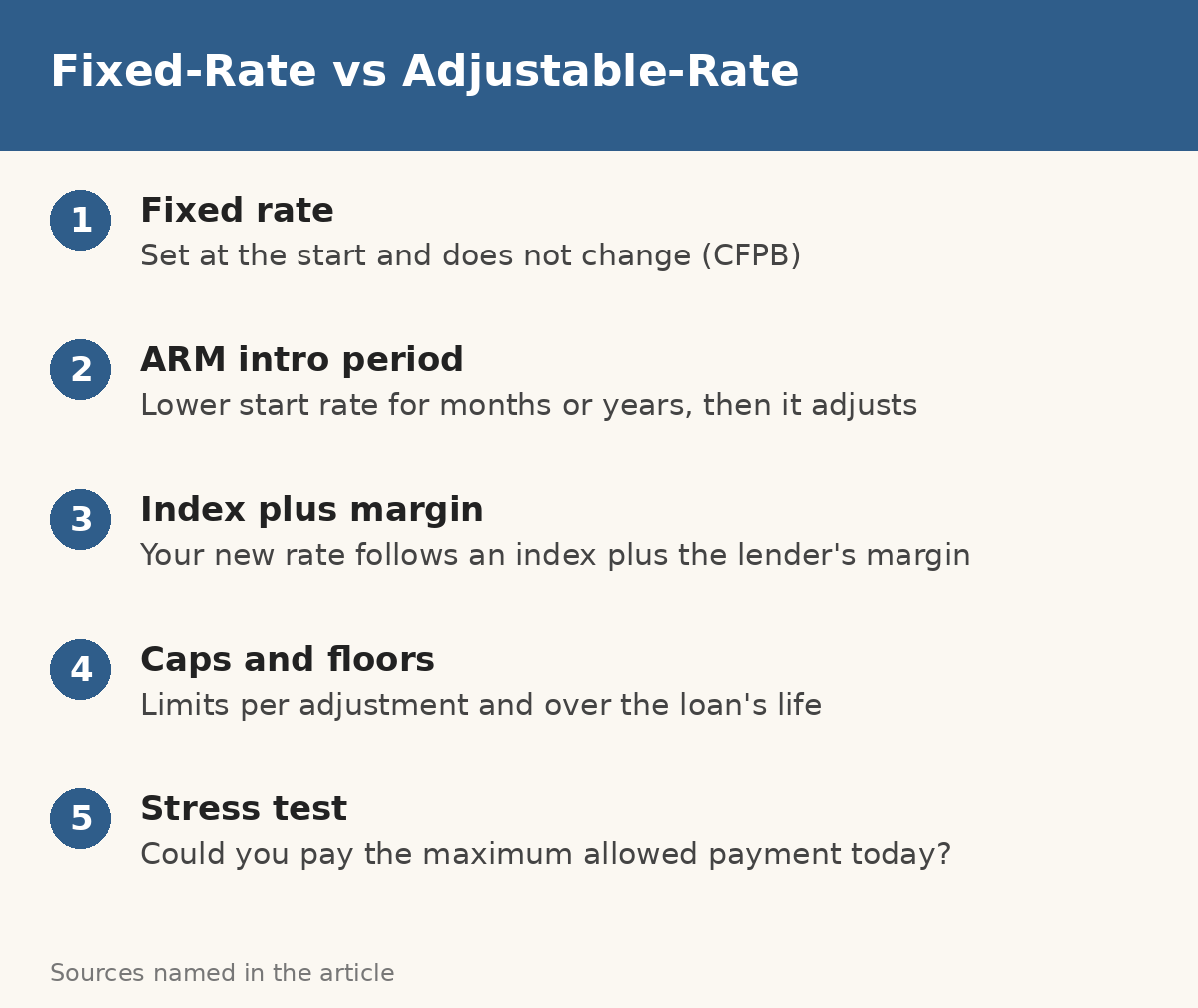
    The CFPB explains that with a fixed-rate mortgage, the interest rate is set when you take out the loan and does not change. With an adjustable-rate mortgage (ARM), the rate can go up or down (CFPB: Fixed-rate vs ARM). Even with a fixed rate, your total monthly payment can still change if your property taxes or insurance change.

    How an ARM moves

    Many ARMs start with a lower rate than fixed-rate loans. That opening rate may last months, a year, or a few years. After the introductory period, the rate changes at regular intervals, and the CFPB notes your payment is likely to go up.

    Three terms decide how far:

    • Index: a broad measure of interest rates that your rate is tied to.
    • Margin: percentage points the lender adds to the index.
    • Caps: limits on how much the rate can rise at one adjustment or over the life of the loan. Some ARMs also set a floor. The first adjustment’s cap can differ from later ones.

    Your new rate is the index plus the margin, subject to the caps.

    Don’t count on selling or refinancing in time

    The CFPB’s key warning: do not assume you can sell or refinance before the rate changes. Home values can fall and your finances can change. If you could not afford the higher payment on today’s income, the CFPB suggests considering a different loan.

    Questions to ask before choosing an ARM

    Based on the CFPB’s checklist, ask the lender:

    1. How high or low can my rate and payment go at each adjustment?
    2. How often does the rate adjust?
    3. How soon could my payment go up?
    4. Is there a cap on how high the rate can go, and a limit on how low?
    5. Could I still afford the loan at the maximum rate and payment the contract allows?

    How to decide

    A fixed rate gives predictability. An ARM may cost less at the start but carries the risk of higher payments later. Compare offers on the Loan Estimate you receive, and get pre-approved first so you know your real budget. See Mortgage Pre-Approval Explained and Credit Score Before a Mortgage. If you are still deciding whether to buy at all, start with our rent vs buy framework.

    FAQ

    Can a fixed-rate mortgage payment change?

    The interest rate cannot, but the CFPB notes the total payment can change with taxes or insurance.

    Will my ARM payment go down if rates fall?

    Sometimes, but not with every ARM. Some set a limit on how low the rate can go.

    What is the margin on an ARM?

    Percentage points the lender adds to the index to set your rate.

    Does this apply in Canada?

    This guide follows US CFPB guidance. Canadian mortgages use different terms, so check with the Financial Consumer Agency of Canada.

    Last checked: 16 November 2026 against the official sources listed below. Rules and figures change; confirm before you act. Educational only, not financial, tax or legal advice.

  • How to Open an FHSA in Canada: Eligibility & Steps

    How to Open an FHSA in Canada: Eligibility & Steps

    A First Home Savings Account (FHSA) is a registered plan that lets a first-time buyer in Canada save toward a qualifying first home tax-free, up to set limits. This guide walks through the eligibility rules and opening steps published by the Canada Revenue Agency (CRA), so you can check whether it fits your plan before you talk to a bank.

    What the FHSA is for

    The CRA describes the FHSA as a way to save to buy or build a qualifying first home tax-free, up to certain limits. Your participation room in the first year you open the account is $8,000. Contributions are generally deductible, which can reduce your income tax, but transfers from your RRSPs into an FHSA are not deductible (CRA: First Home Savings Account).

    Who can open one

    According to the CRA, you must meet all of these conditions when you open the account (CRA: Opening your FHSAs):

    • Age: at least 18 (19 in provinces and territories where that is the age to enter a contract), and no older than 71 on December 31 of the year you open it.
    • Residency: you are a resident of Canada.
    • First-time buyer: you did not live, as your main home, in a home you owned or jointly owned in the current calendar year or the previous four calendar years. The same test applies to a home owned by your spouse or common-law partner, if you have one.

    The CRA’s own example: someone who co-owned and lived in a home from 2021 until selling it in 2024 is not treated as a first-time buyer for an account opened in 2025.

    What counts as a qualifying home

    A qualifying home is a housing unit in Canada, including one under construction. The CRA lists single-family and semi-detached homes, townhouses, mobile homes, condo units, apartments in duplexes to apartment buildings, and co-op shares that give you an equity interest. A co-op share that only gives you a right to live there does not qualify.

    How to open an FHSA

    1. Contact an FHSA issuer, such as a bank, credit union, trust company, or insurance company.
    2. Give them your social insurance number, your date of birth, and any documents they need to confirm you qualify.
    3. Consider naming a beneficiary.

    Accuracy matters. The CRA warns that if information you gave turns out to be wrong, the account’s registration can be revoked back to the date it was opened. Contributions would then not be deductible and income would be taxable.

    The tax-return step people miss

    For the year you open your first FHSA, you must file Schedule 15 with your income tax and benefit return, even if you put no money in. This tells the CRA the account exists.

    Types of FHSA

    The CRA lists three: a depositary FHSA (cash, term deposits, GICs), a trusteed FHSA (which can hold qualified investments such as bonds, mutual funds, and listed securities), and an insured FHSA (an annuity contract). Self-directed accounts are also possible. Ask your issuer which they offer.

    How it fits your buying plan

    An FHSA is one piece of your down payment plan. To see how the down payment interacts with mortgage insurance, read Down Payment and Mortgage Insurance in the US and Canada. For the full sequence of steps, see First-Time Homebuyer Basics in Canada.

    FAQ

    Can I open an FHSA if my spouse owns our home?

    Generally no. The CRA’s example says a person living in a home owned by their common-law partner is not a first-time buyer for FHSA purposes.

    Do I have to put money in during the first year?

    No, but you still file Schedule 15 for the year you open your first FHSA.

    Where do I open one?

    Through an FHSA issuer: a bank, credit union, trust company, or insurance company.

    Is this tax advice?

    No. This is a summary of CRA guidance. Check your own situation with the CRA or a qualified adviser.

    Last checked: 16 November 2026 against the official sources listed below. Rules and figures change; confirm before you act. Educational only, not financial, tax or legal advice.
    Related